Goal-Based Financial Planning


Introduction
Most people budget to survive the month, but the real purpose of budgeting is direction. Your money is supposed to be moving you somewhere.
The problem is that most budgeting tools stop at tracking the past. When it comes to long-term goals, they leave you guessing. Even modern budgeting apps that do track goals treat them like isolated piggy banks. They don't show you how adding a new goal delays your others, or whether your day-to-day cash flow will actually get you there on time.
Real financial goals compete for the same dollars, If your tools can't connect your goals to your cash flow or predict the future with aerospace-grade precision, they can't warn you when you're drifting off track. You deserve a system that treats your priorities as a living, adaptive network.
Thats why we are building the Catosphere Goal Planning System (GPS). Read on to see how it works and try out the interactive demo at the end to see how your goals stack up.
The Catosphere Goal Planning System (GPS)
While our aerospace-grade simulation engine handles the heavy math behind Vision-Aligned Budgeting, goals are how you visually define what your roadmap actually looks like.
Instead of treating goals as isolated savings buckets, we treat them as nodes in a living financial system. Money flows through them sequentially, they influence each other, and they automatically adapt as your life changes.
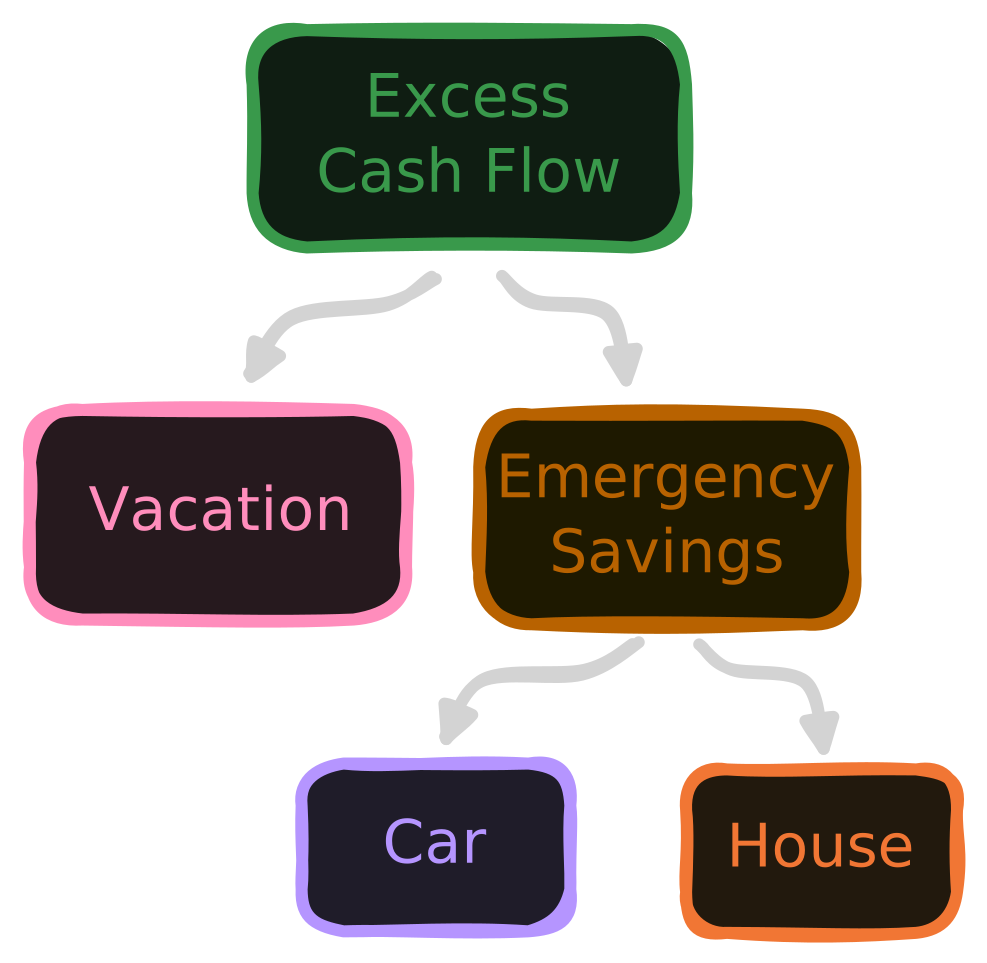
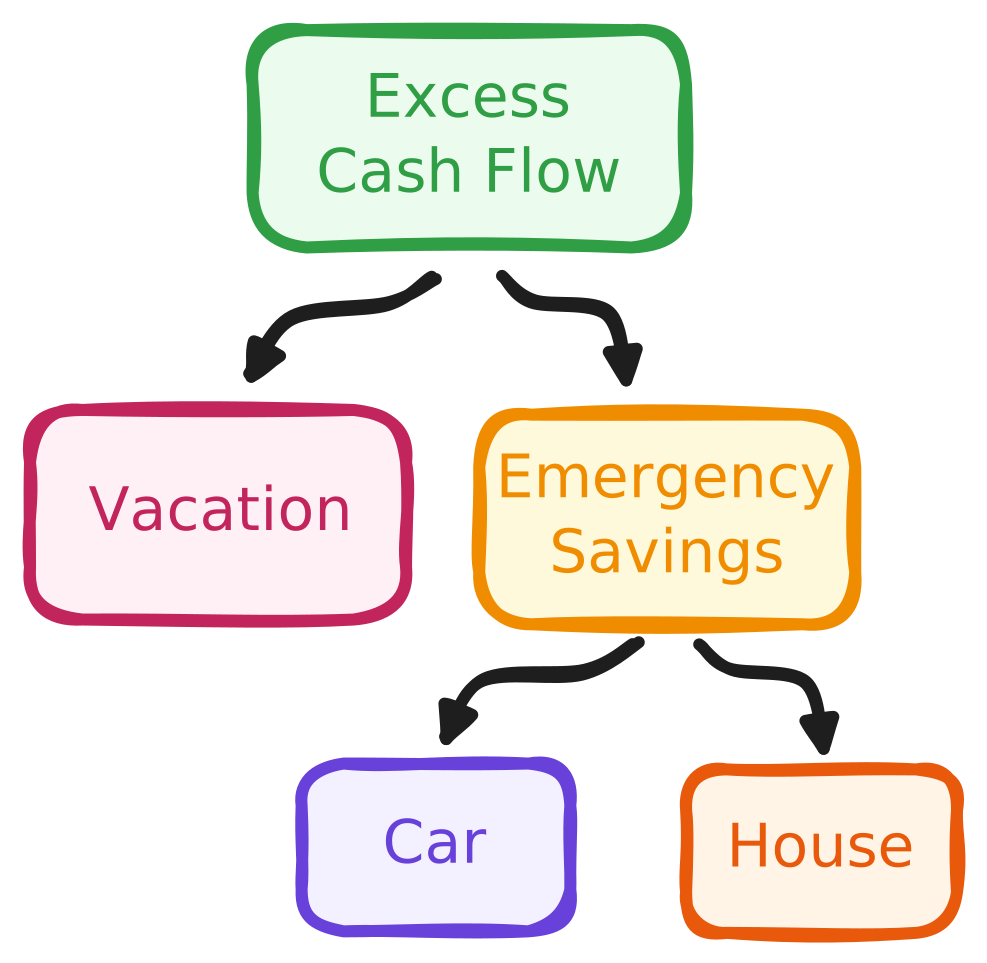
The starting point of your plan is your excess cash flow. From there, your priorities are defined completely by the structure. Goals closer to the top of the tree receive funding first, and deeper goals only activate once their predecessors are met. This lets you design your financial future visually, in a way that makes sense to you.
This structure matters because it makes your financial life predictable. When goals are connected, you can see exactly how adding, removing, or re-prioritizing them cascades through your financial plan. Instead of guessing how a new car purchase impacts your retirement timeline, the GPS instantly maps it out for you.
The Four Types of Goals
For the purposes of this demo, there are four types of goals that you can use to design your own plan. We'll walk through each one after introducing the source of your cash flow.

Controls Menu
Monthly Cash Flow
The Monthly Cash Flow node defines the net surplus money you have available to fund your long-term plans. While this demo uses simple income and expense inputs, the production Catosphere engine will automatically calculate your cash flow by running predictive analysis over your historical income and expenses.
How Goals Interact
Now that you know the basics of how individual goals work, let's look at a textbook example of how they interact with each other in a real plan.


Controls Menu
The GPS uses a clear set of rules to determine exactly how your money flows through your goal tree. Your money is automatically routed based on three things: where the goal sits in the tree, the type of goal it is, and the priority you assign to it.
Structural Priority
As you drag the timeline slider in the demo, you will see that your money flows from the top down. In this example, your money goes toward your emergency savings and your "Fun Money" sinking fund first. Only when the Emergency Savings goal is completely filled will the leftover cash begin to flow down into the next level of goals.
There is no limit to how deep you can nest your goals, giving you the power to make your future plans depend on one another.
Static Priority
Because Static goals have a locked-in calendar deadline, the system automatically calculates exactly how much monthly cash they need to finish on time. For this reason, they automatically take precedence over other goals on the same level.
The GPS does this because static goals are usually "needs" (like a fixed bill), while dynamic goals are flexible "wants." A static goal will absorb whatever cash flow it needs to stay on track until it is either fully funded or its deadline passes. This is why the Retirement goal in the example doesn't start making real progress until the New Car goal is completely taken care of.
Dynamic Priority
For goals that run side-by-side on the same level of your tree, like Emergency Savings and Sinking Funds, you can set a priority value to split your cash flow between them.
In the example above, the Emergency Savings goal has a priority of 9, while the Fun Money goal has a priority of 1. As you move the timeline, you'll see that for every $1.00 that goes into your Fun Money, $9.00 automatically go toward your emergency savings.
Once the Emergency Savings goal is fully met, that $9.00 stream doesn't just sit there. Instead, it automatically cascades down to fund the next level of goals, while your Fun Money continues growing smoothly at its steady pace.
The Demo
Now that you understand the basics of the Catosphere Goal Planning System, you are ready to build a sample layout yourself. As you play around with the full demo below, your plan will automatically save to your browser so you don't lose your work if you refresh the page or return to the main homepage later.
Scroll the page so that the demo canvas fills your whole screen for the best experience.
On mobile, the background now blocks your ability to scroll. Please scroll by dragging above the demo or on the controls panel at the bottom of the demo.
Controls Menu
The Full Version
Our plans for the full Goal Planning System go far beyond what you see in this sandbox. In the full version of Catosphere:
- 1. Goals won't have rigid types at all. You will always be able to fluidly mix and match behaviors to fit any unique scenario.
- 2. Your goals will tie directly into our advanced simulation engine, giving you realistic time ranges for when you'll cross the finish line rather than guessing with statistical averages.
- 3. The predicted growth of your milestone money will dynamically adapt to reflect your exact real-world investment strategy and asset allocation.
Your Finances, Thoroughly Planned
Most tools treat your goals as an afterthought, but they are the foundation of your personal finances. Neglecting to set a real, achievable plan puts your future in jeopardy.
At Catosphere, we're bridging the gap between daily budgeting and long-term planning. By connecting your goals and your spending, to our aerospace-grade simulation, the path forward becomes clear. Leave the guesswork behind and embrace data-backed confidence.
We are currently in active development of our suite of personal finance tools. If you want an approach to personal finance that adapts to your life instead of fighting it, join our waitlist. You'll help shape the future of Vision-Aligned Budgeting and have a chance to participate in our early access program.